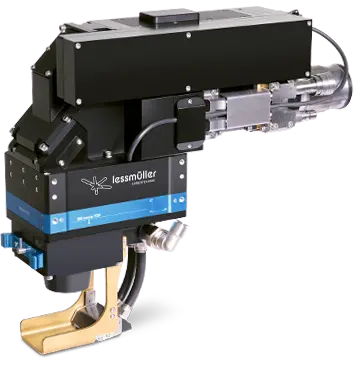

Laser Welding Processes Monitoring and Quality Assurance

View all
Lessmuller Overview

Laser Welding Process Monitoring for Quality, Traceability, and Control

Lessmuller laser welding monitoring technologies help manufacturers see, measure, guide, and document the laser welding process in real time. Li10 supports North American customers with Lessmuller equipment selection, integration guidance, installation, commissioning, troubleshooting, and process optimization.

Real-Time Process Visibility

  • Visualize the active laser welding process as it happens
  • Record image data, process parameters, and control data
  • Support seam tracking, weld pool observation, and defect analysis
  • Improve process understanding during development and production

Quality Assurance

  • Detect weld defects, seam interruptions, and process deviations
  • Compare production welds against trained reference welds
  • Measure weld penetration depth with OCT monitoring
  • Reduce scrap, rework, inspection cost, and production risk

Li10 Support

  • North American sales and service support for Lessmuller systems
  • Installation, commissioning, troubleshooting, and operator support
  • Application review for OCT, LSO, Weldcheck, and Weldeye solutions
  • Process optimization for demanding laser welding production environments
Li10 helps manufacturers turn laser welding data into better production decisions. From seam tracking and weld depth measurement to online defect detection and traceability, Lessmuller systems give production teams the visibility needed to improve quality and reduce risk.
Discuss Your Application


Laser Welding Quality Assurance Video Library

Li10 LLC

We are excited to hear from our customers. Call us now or fill out our contact form.

Loading...
Lessmuller FAQ

Common Questions About Lessmuller Laser Welding Process Monitoring

Learn how Lessmuller sensor technology helps manufacturers monitor laser welding quality, track seams, measure weld depth, detect defects, and improve production traceability.
What does Lessmuller laser welding process monitoring do?

Quick answer: Lessmuller laser welding process monitoring systems help manufacturers see, measure, guide, and document what is happening during the laser welding process.

The details: In production laser welding, the weld can happen very quickly and in a very small process zone. Lessmuller monitoring technology helps bring visibility to that process through tools for seam tracking, weld observation, defect detection, weld depth measurement, image capture, and process data recording.

These systems are often used when manufacturers need more control over weld quality, more repeatable production, and better documentation of the laser welding process.

What is OCT in laser welding?

Quick answer: OCT stands for optical coherence tomography. In laser welding, OCT can be used to measure the weld area, track the seam, observe the process, and help evaluate weld penetration depth in real time.

The details: OCT gives manufacturers a way to collect measurement data from the laser welding process without physically touching the part. This can be especially useful in automated welding lines where weld quality needs to be monitored continuously.

Lessmuller OCT technology can support seam tracking, process observation, seam monitoring, and weld depth measurement depending on the application and system configuration.

Why is weld depth measurement important?

Quick answer: Weld depth measurement helps verify that the laser weld is reaching the required penetration instead of relying only on visual inspection after the part is complete.

The details: A weld can sometimes look acceptable on the surface while still failing to meet internal penetration requirements. That is a major risk in applications where weld strength, sealing, electrical performance, or part safety are critical.

Real-time weld depth measurement helps production teams identify process drift, missed penetration, and changing weld conditions earlier, reducing the chance that bad parts continue through the line.

What is WELDEYE used for?

Quick answer: WELDEYE is used for real-time visualization, monitoring, and quality assurance in laser welding applications.

The details: WELDEYE helps operators and production teams observe the laser welding process, monitor weld behavior, and evaluate process conditions while welding is happening. It can support seam tracking, image recording, process data evaluation, and automatic defect detection depending on the system setup.

For manufacturers running automated or high-volume laser welding, this kind of real-time process visibility can help reduce scrap, troubleshoot issues faster, and improve confidence in weld quality.

Can Lessmuller systems detect weld defects automatically?

Quick answer: Yes. Depending on the system and application, Lessmuller monitoring technology can support automatic defect detection during the laser welding process.

The details: Automatic defect detection can help identify process problems such as seam misalignment, lack of penetration, surface irregularities, process instability, or other weld quality issues. The exact detection capability depends on the application, sensor package, weld geometry, material, and quality requirements.

For high-volume production, automatic defect detection can reduce reliance on manual inspection and help operators respond to problems before large batches of parts are affected.

Can Lessmuller monitoring systems be integrated into existing laser welding lines?

Quick answer: Yes. Lessmuller systems can often be integrated into new or existing automated laser welding cells, depending on the process, laser head, controls, available space, and quality goals.

The details: Integration planning is important because process monitoring needs to work with the laser, optics, motion system, PLC, robot, fixtures, and production controls. The right configuration depends on whether the goal is seam tracking, weld depth measurement, visual monitoring, defect detection, data recording, or full process control.

Li10 can help evaluate the existing line, determine what monitoring technology fits the process, and support installation, commissioning, troubleshooting, and optimization.

What industries use Lessmuller laser welding monitoring technology?

Quick answer: Lessmuller technology is used in industries where laser weld quality, repeatability, traceability, and process control are critical.

The details: Common application areas include automotive, e-mobility, battery manufacturing, medical technology, powertrain components, white goods, mechanical engineering, and other precision manufacturing environments.

These industries often require high-volume production, consistent weld quality, documented process data, and fast detection of weld defects or process drift.

How does process monitoring help reduce scrap and rework?

Quick answer: Process monitoring helps identify weld problems earlier, allowing operators or automated systems to respond before defective parts continue through production.

The details: Without monitoring, weld problems may not be found until final inspection, leak testing, destructive testing, or field failure. By that point, many parts may already be complete, creating scrap, rework, downtime, and quality risk.

Lessmuller monitoring systems help detect process drift, seam position problems, penetration issues, and other weld quality concerns closer to the moment they happen. This gives manufacturers a better chance to correct the process quickly and protect production quality.

Can Lessmuller systems support traceability?

Quick answer: Yes. Lessmuller systems can support traceability by recording process images, weld data, measurement data, and quality-related information during production.

The details: Traceability is important when manufacturers need to prove that parts were welded within process limits or document quality for customer, regulatory, or internal production requirements.

Recorded process data can help with quality documentation, troubleshooting, production audits, and continuous process improvement.

Is Lessmuller monitoring only for automated laser welding?

Quick answer: Lessmuller monitoring technology is most commonly used in automated or semi-automated laser welding environments, but the right fit depends on the application and quality requirements.

The details: Automated laser welding lines benefit the most from real-time monitoring because the process is fast, repeatable, and often high volume. Monitoring can help verify that the automated process stays within the required limits.

For lower-volume or manual processes, the value depends on the risk level, part requirements, documentation needs, and whether the process justifies additional sensing and monitoring technology.

Can Li10 help with Lessmuller installation and support?

Quick answer: Yes. Li10 supports Lessmuller customers with equipment selection, application review, installation, commissioning, troubleshooting, and process optimization.

The details: Process monitoring is not just a hardware purchase. To get value from the system, it needs to be matched to the application, installed correctly, integrated into the line, and tuned around real production requirements.

Li10 helps North American manufacturers evaluate Lessmuller technology, plan the integration, support startup, and improve the laser welding process over time.