

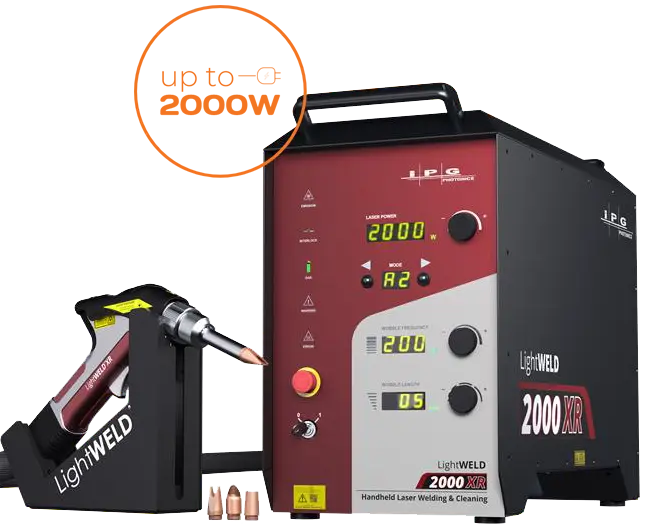
Featured Handheld Laser Welders

View all
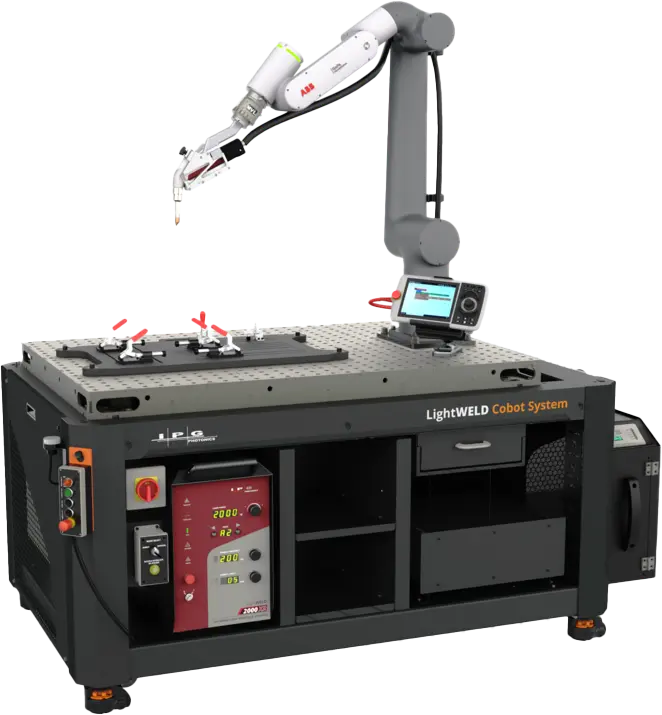
IPG LightWELD Cobot System for automated laser welding and cleaning
LightWELD Cobot Automation

Automated Laser Welding with the IPG LightWELD Cobot System

The IPG LightWELD Cobot System brings collaborative robot automation to LightWELD laser welding and cleaning, helping shops automate repetitive welds without moving straight to a large robotic welding cell.

For manufacturers running repeat parts, high-mix fabrication, or labor-constrained welding operations, cobot laser welding can improve consistency, increase throughput, and free skilled welders for higher-value work.

Collaborative robot laser welding for repeatable production work
Compatible with LightWELD laser welding and cleaning sources
Useful for repetitive welds and high-mix, low-volume fabrication
A practical bridge from handheld laser welding to automation
Discuss Cobot Welding
LightWELD Overview

Handheld Fiber Laser Welding Systems Built for Speed, Quality, and Ease of Use

IPG LightWELD handheld fiber laser welding systems help manufacturers produce clean, consistent welds with less heat input, faster travel speeds, and a shorter learning curve than many traditional welding processes.

Fiber Laser Welding Performance

  • Fast, clean handheld fiber laser welding for production and fabrication environments
  • Focused fiber laser energy supports faster travel speeds than many MIG and TIG applications
  • Low heat input helps reduce distortion, deformation, and burn-through
  • Strong, consistent weld quality across a wide range of materials and thicknesses

Process Flexibility

  • Welding and laser cleaning capability in a compact handheld fiber laser platform
  • Factory presets help simplify setup for common material and thickness combinations
  • Wobble welding supports seam control and less-than-perfect part fit-up
  • Single and dual wire feeder options are available for added fill and application range

Li10 Support

  • Equipment guidance for LightWELD handheld fiber laser welding systems and accessories
  • Application support for welding, cleaning, setup, and process optimization
  • Fiber laser safety guidance, enclosures, PPE, fume extraction, and workspace planning
  • Demo, training, and support options from experienced laser welding professionals
Li10 Laser helps manufacturers get more from LightWELD handheld fiber laser systems with equipment selection, application knowledge, fiber laser safety support, and practical guidance for welding, cleaning, accessories, and automation opportunities.
Discuss Your Application

Featured LightWELD Accessories

View all


IPG LightWELD Video Library

Li10 LLC

We are excited to hear from our customers. Call us now or fill out our contact form.

Loading...

Why LightWELD?

Up to 5/16 inch welding capability icon

Up to 5/16" Welding Capability

4X faster than TIG icon

4X Faster Than TIG

100 welding and cleaning presets icon

100 Welding & Cleaning Presets

Up to 2 kilowatts of laser power icon

Up to 2 kW of Laser Power

Easy to learn and operate icon

Easy to Learn & Operate

LightWELD FAQ

Common Questions About IPG LightWELD Handheld Laser Welding

Learn how IPG LightWELD compares to traditional welding, lower-cost handheld laser welders, and automated laser welding options for modern fabrication environments.
What makes IPG LightWELD different from cheaper handheld laser welders?

Quick answer: The biggest differences are reliability, fiber laser source quality, safety systems, process consistency, and long-term support. Many lower-cost handheld laser welders may look similar externally, but the real differences show up in uptime, weld quality, cooling performance, software stability, and how quickly problems get solved when something goes wrong.

The details: Not all handheld laser welders are built to the same standard. Systems built around premium fiber laser sources, like IPG LightWELD, typically deliver more stable beam quality, better process control, longer component life, and stronger integration of safety systems.

Another major difference is support infrastructure. Li10 helps customers evaluate reliability, serviceability, process capability, operator training, laser safety equipment, and long-term ROI, not just the upfront equipment price.

How hard is it to learn handheld laser welding?

Quick answer: Most operators learn handheld laser welding much faster than TIG welding. Many shops can get operators producing acceptable welds within hours or days instead of the years often required to become highly proficient at TIG.

The details: Modern handheld laser welding systems include adjustable wobble patterns, preloaded material presets, and intuitive controls that help operators achieve consistent welds faster with less technique sensitivity.

Operators still need to understand fit-up, travel speed, focus position, shielding gas setup, cleaning requirements, and safety procedures. Li10 provides hands-on training, setup guidance, and laser process improvement support to help customers get productive quickly and safely.

Can handheld laser welding replace MIG or TIG welding?

Quick answer: For many thin-to-medium gauge fabrication applications, yes. Handheld laser welding can replace MIG or TIG on a large percentage of stainless, aluminum, and sheet metal work while increasing speed and reducing cleanup.

The details: Compared to traditional arc welding, fiber laser welding typically produces faster travel speeds, smaller heat-affected zones, less distortion, minimal spatter, reduced grinding, and cleaner cosmetic welds.

Traditional MIG and TIG still make sense for heavy plate, large-gap joints, and certain code-driven applications. Li10 helps customers determine which parts are the right fit through application review, sample work, and contract laser welding services.

Is handheld laser welding worth the higher price?

Quick answer: For many manufacturers, yes. Shops often justify the higher investment through faster production, lower labor cost per part, reduced grinding and rework, easier operator training, and improved consistency.

The details: Most ROI calculations come down to labor savings, reduced finishing, lower scrap, faster training, and increased throughput without adding headcount.

Li10 helps customers model ROI using actual parts, labor rates, production volume, and workflow. For shops not ready to purchase immediately, laser production services can also help validate parts and process needs before a larger equipment investment.

What materials can handheld laser welders weld?

Quick answer: Handheld laser welders are commonly used on stainless steel, mild steel, galvanized steel, aluminum, copper, titanium, and nickel alloys.

The details: Actual weld capability depends on material thickness, joint design, fit-up quality, laser power, travel speed, beam wobble settings, and joint preparation.

Li10 helps customers evaluate real-world weldability through part testing, application review, and laser process development rather than relying only on theoretical thickness charts.

Does handheld laser welding really reduce grinding and cleanup?

Quick answer: In many applications, dramatically. Handheld laser welding produces cleaner welds with minimal spatter, lower heat input, and less distortion.

The details: Because laser welding uses concentrated energy with a smaller heat-affected zone, welds are typically narrower, cleaner, and more cosmetically consistent than MIG welding.

For many manufacturers, the labor savings downstream of the weld operation is what drives the ROI. Shops can also support cleaner work areas with Fume Dog downdraft tables and fume extractors when welding, cleaning, or grinding creates airborne contaminants.

Is handheld laser welding safe?

Quick answer: Yes, when proper laser safety procedures are followed. The primary risks are eye exposure from direct or reflected laser beams, skin burns, fumes, and electrical hazards.

The details: Standard welding helmets do not protect against the 1070 nm wavelength used by most industrial fiber lasers, so operators need wavelength-specific laser safety glasses, proper beam containment, and controlled work areas.

Li10 helps customers plan laser-safe enclosures, signage, interlocks, fume extraction, PPE, and workspace procedures for safe handheld laser welding.

Why is handheld laser welding faster than MIG or TIG welding?

Quick answer: Handheld laser welding is faster because the laser delivers concentrated energy directly into the joint without relying on slower puddle control and filler deposition methods.

The details: The focused fiber laser beam creates rapid localized fusion with a smaller heat-affected zone, allowing operators to move faster while maintaining penetration and weld quality.

Laser welding can also reduce secondary operations like spatter removal, straightening, grinding, and finishing. For more background, see Li10's article on how IPG LightWELD is changing welding shop operations.

What thicknesses can the IPG LightWELD actually weld?

Quick answer: Most IPG LightWELD applications fall between roughly 0.5 mm and 8 mm material thickness, depending on material type, joint design, fit-up quality, and system power level.

The details: Actual performance depends on material type, joint geometry, gap tolerance, weld position, edge condition, travel speed, shielding gas setup, and operator technique.

Li10 works with customers to evaluate actual parts and joint designs during demos and testing. Customers can also review available handheld laser welders to compare LightWELD models and system options.

What are the best applications for handheld laser welding?

Quick answer: Handheld laser welding performs best on thin-to-medium gauge stainless steel, aluminum, sheet metal, and cosmetic weld applications where speed, appearance, low distortion, and reduced post-processing matter most.

The details: Strong applications include stainless food equipment, aluminum fabrication, sheet metal enclosures, HVAC components, automotive parts, battery assemblies, cosmetic seams, and thin-wall tubing.

Li10 helps customers identify which specific parts are the strongest fit for laser welding. Battery-focused manufacturers may also want to review RMA battery laser welding systems.

When does handheld laser welding NOT make sense?

Quick answer: Handheld laser welding is usually not the best choice for extremely thick plate, large-gap joints, dirty material, poor fit-up, or certain heavy structural and code-critical applications.

The details: Laser welding is a precision-driven process. It rewards good part preparation, controlled fit-up, and repeatable production environments.

Li10 helps customers evaluate where laser creates value, where traditional welding should remain in place, and where hybrid workflows make sense through laser troubleshooting and application support.

What's the difference between air-cooled and water-cooled handheld laser welders?

Quick answer: Air-cooled handheld laser welders are lighter, more compact, easier to move, and simpler to install because they do not require a separate water chiller.

The details: IPG LightWELD is air-cooled, which helps make it practical for fabrication shops that need a shop-floor-ready system without adding extra equipment, plumbing, or maintenance.

Li10 helps customers consider where the machine will be used, how often it needs to move, what materials are being welded, and what LightWELD accessories may be needed for the workflow.

How do I know if my shop is ready for laser welding?

Quick answer: If your shop struggles with welder shortages, slow TIG production, excessive grinding, cosmetic consistency issues, or throughput bottlenecks, you may be a strong candidate for laser welding.

The details: Strong indicators include thin stainless or aluminum production, distortion-sensitive parts, cosmetic weld requirements, and growing demand without enough labor capacity.

Li10 starts with part review, sample welding, and ROI analysis using your actual production environment. For broader production planning, Li10 also supports laser integration and automation services.

Are handheld laser welders becoming the new standard in fabrication?

Quick answer: In many thin-to-medium gauge fabrication environments, yes. Adoption is growing because laser welding helps address labor shortages, improve throughput, reduce rework, and achieve more consistent weld quality.

The details: Traditional MIG and TIG are not disappearing. The trend is toward hybrid workflows where laser handles the applications where it creates the biggest operational advantage.

As shops grow beyond handheld work, Li10 can help evaluate laser welding automation, cobot welding, robotics, and process monitoring options.

How much labor can handheld laser welding actually save?

Quick answer: On compatible parts, handheld laser welding can significantly reduce total welding labor when faster weld speeds, reduced grinding, less straightening, lower rework, and shorter training time are included.

The details: The actual savings depend on part mix, material type, existing welding process, production volume, cosmetic requirements, and current labor costs.

Li10 helps customers calculate real-world labor impact using actual workflows and production data, then determine whether handheld welding, laser welding cobots, or a larger automation plan makes the most sense.

Can handheld laser welding be automated?

Quick answer: Yes. Many manufacturers begin with handheld laser welding and later automate the process using cobots or full robotic laser welding cells.

The details: Cobot laser welding is often a practical first step into automation because it can be easier to program, faster to deploy, more flexible for mixed production, and better suited for smaller shops than large robot cells.

Li10 helps customers evaluate both manual and automated pathways. Review the IPG LightWELD Cobot System or learn more about Li10's laser integration and automation services.