

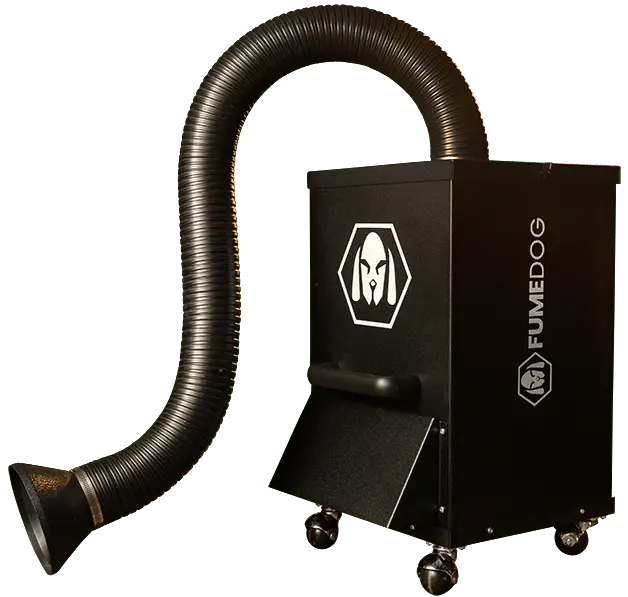
Fume Dog downdraft tables and fume extractors help capture welding smoke, grinding dust, and airborne contaminants closer to the source. Li10 helps shops choose practical extraction solutions for laser welding areas, fabrication cells, training spaces, and production workstations.


We are excited to hear from our customers. Call us now or fill out our contact form.
Quick answer: A Fume Dog downdraft table pulls welding fumes, grinding dust, and airborne contaminants downward through the work surface so they can be filtered before spreading through the shop.
The details: Downdraft tables are useful when operators need source capture directly at the workbench. Instead of relying only on general ventilation or moving an extraction arm for every weld, a downdraft table helps capture smoke and dust where the work is happening.
This makes downdraft tables a practical fit for welding, grinding, repair, training, fabrication, and laser process areas where cleaner air and better visibility matter.
Quick answer: A downdraft table captures fumes and dust through the table surface, while a fume extractor typically captures contaminants through an arm, hose, hood, or intake placed near the work.
The details: Downdraft tables are best when the work happens on a table and the operator wants source capture built into the workstation. Portable or wall-mounted fume extractors are better when the capture point needs to move around a part, a booth, or a changing work area.
Many shops use both. A downdraft table may handle bench work and grinding, while a portable or wall-mounted extractor supports larger parts, fixed welding booths, or jobs that cannot be positioned on a table.
Quick answer: Fume Dog downdraft tables can be used for welding, grinding, light fabrication, repair work, training environments, and source capture around metalworking processes.
The details: Downdraft tables are especially helpful when weld smoke or grinding dust is created directly at the work surface. Common uses include MIG welding, TIG welding, stick welding, grinding, deburring, fixture work, small assemblies, and fabrication tasks that benefit from a cleaner workstation.
For Li10 customers, downdraft tables may also be useful around handheld laser welding areas where smoke and particulate control are important parts of the total workspace plan.
Quick answer: A portable fume extractor is a good choice when welding or fabrication work moves around the shop, when multiple work areas need occasional capture, or when a fixed extraction system is not practical.
The details: Portable fume extractors give shops flexibility. They can be moved closer to the work, used near different welding stations, or repositioned as production needs change. This can be helpful for repair work, training spaces, smaller fabrication shops, or facilities that do not have permanent ducted extraction.
Li10 can help determine whether a portable unit, downdraft table, wall-mounted extractor, or combination of systems is the right fit for your workspace.
Quick answer: A wall-mounted fume extractor makes sense for fixed welding stations, dedicated booths, or work areas where operators need extraction in the same location every day.
The details: Wall-mounted extractors help keep floor space open while providing source capture near a dedicated work area. They can be a practical fit for welding booths, training stations, production cells, and shop layouts where a portable unit would be in the way.
Fume Dog wall-mounted extractor options include systems designed around high-efficiency MERV 15 filtration, helping support cleaner air in work areas where welding fumes and airborne particles are a concern.
Quick answer: Many Fume Dog systems use high-efficiency MERV 15 nanofiber fire-retardant filters designed to capture welding fumes, dust, and fine airborne particles.
The details: The filter is one of the most important parts of a fume extraction system. Fume Dog lists nanofiber replacement filters for portable, downdraft table, platen table, and Bulldog systems, with certain exceptions depending on the model.
Proper filter selection and replacement helps maintain airflow, capture performance, and system reliability. Li10 can help customers think through filter needs based on application, material type, usage level, and shop environment.
Quick answer: A platen or acorn table surface can make a downdraft table more useful as both a fume extraction workstation and a flexible welding or fabrication table.
The details: Fume Dog downdraft table options can include platen/acorn-style table surfaces that support clamping and tooling. This helps operators hold parts, position fixtures, and perform fabrication work while still capturing fumes and dust through the workstation.
For shops that need both workholding and source capture, a platen downdraft table may be more practical than a basic extraction table alone.
Quick answer: Yes. Fume Dog downdraft tables and fume extractors can be considered for laser welding areas where smoke, fumes, and particulates need to be captured near the source.
The details: Handheld laser welding, traditional welding, and grinding can all create airborne contaminants. The right extraction approach depends on the application, material, part size, operator workflow, and workstation layout.
Li10 helps customers look at the full laser process area, including the welding equipment, workholding, fume extraction, operator movement, laser safety planning, and ongoing filter maintenance.
Quick answer: The right fume extraction system depends on the process, material, part size, work area, operator movement, production volume, and whether source capture is needed at a table, arm, booth, or portable workstation.
The details: A shop that mostly welds small parts at a bench may be a good candidate for a downdraft table. A shop with changing work areas may need a portable extractor. A fixed welding booth may be better served by a wall-mounted system or dedicated extraction arm.
Li10 can help evaluate your workflow, workspace, welding process, and air quality goals to recommend a practical Fume Dog setup.
Quick answer: Yes. Li10 can help customers choose Fume Dog downdraft tables and fume extractors based on the application, workspace, source capture needs, and long-term filter maintenance requirements.
The details: Fume extraction should be planned around the real workflow, not just the equipment catalog. Li10 can help review whether your shop needs a downdraft table, portable extractor, wall-mounted system, replacement filters, welding booth accessories, or a combination of solutions.
The goal is to support cleaner air, better operator comfort, practical source capture, and a more efficient welding or fabrication workspace.
We use cookies to improve your experience. Privacy Policy.