

Optical Coherence Tomography (OCT) in Laser Welding: Advancing Quality Control and ROI
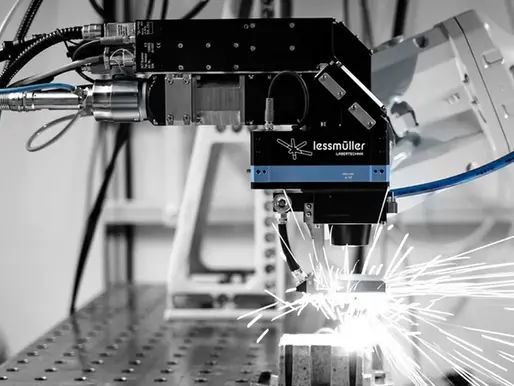
In today’s manufacturing landscape, achieving consistent, high-quality laser welds while maintaining production efficiency is essential for staying competitive. Optical Coherence Tomography, commonly known as OCT, has emerged as a powerful technology for laser welding process monitoring and control.
OCT gives manufacturers real-time insight into the weld process, helping teams improve quality control, reduce scrap, document results, and make stronger decisions on the production floor.
Understanding OCT in Laser Welding
Optical Coherence Tomography uses low-coherence interferometry to provide high-resolution, cross-sectional imaging of welding processes in real time. Think of it like ultrasound for light. Instead of using sound waves, OCT uses light waves to achieve far greater precision and detail.
This makes OCT especially valuable for laser welding applications where weld depth, keyhole stability, seam tracking, and defect detection all matter.
- Penetration depth: Real-time laser weld depth measurement helps confirm that welds meet structural requirements.
- Keyhole formation and stability: Monitoring the keyhole helps manage molten material flow and reduce defects.
- Weld seam geometry: OCT supports proper alignment, weld uniformity, and seam tracking in laser welding.
- Surface defects: The process can identify imperfections such as porosity, spatter, or roughness.
OCT is particularly useful for non-destructive testing in medium- to high-volume laser welding applications, including automotive, aerospace, electronics, battery manufacturing, and other quality-critical production environments.
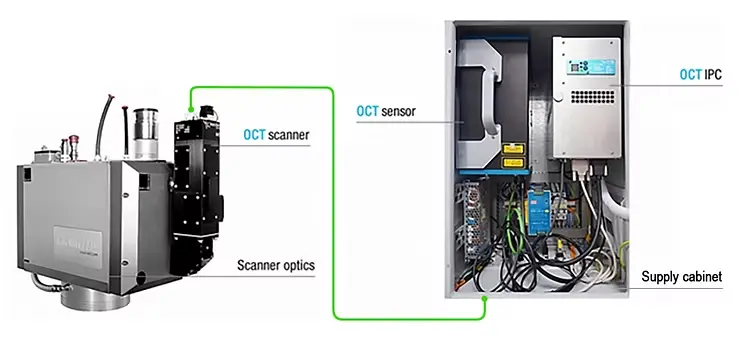
The Real ROI of OCT Implementation
The business case for OCT becomes clear when manufacturers look at both direct cost savings and indirect operational benefits. Traditional quality control methods often find defects after the weld has already been completed. OCT helps detect process variation earlier, allowing manufacturers to reduce waste and improve process confidence.
- Reduced scrap and rework: Real-time laser welding process monitoring helps reduce material waste and costly rework.
- Minimized destructive testing: OCT can reduce reliance on destructive testing while preserving valuable components.
- Accelerated production speeds: With stronger quality confidence, manufacturers can often increase welding speeds without compromising results.
- Labor cost optimization: Automated inspection can reduce manual oversight while improving inspection accuracy.
- Quality documentation and traceability: OCT systems can automatically generate weld quality records for compliance, review, and process improvement.
OCT Turns Weld Monitoring Into Business Intelligence
By capturing real-time process data, OCT helps manufacturers move from reactive inspection to proactive quality control. That shift can reduce waste, improve throughput, and make weld quality easier to document.
Li10 and Lessmüller: A Partnership for Laser Welding Process Monitoring
Li10 provides North American sales and service support for Lessmüller Lasertechnik technology, giving manufacturers access to advanced OCT-based welding process monitoring sensor systems. Lessmüller solutions are designed for integration into modern laser welding monitoring systems and production environments.
- Streamlined form factor: Compact designs fit easily into a wide range of manufacturing setups.
- High scanning rates: Real-time monitoring supports stronger process control and defect prevention.
- Broad compatibility: Lessmüller OCT systems are compatible with many common laser optics.
- Seamless integration: Systems can be integrated into existing production workflows to minimize disruption.
- Advanced analytics and reporting: Data can support weld depth measurement, seam tracking, and automated documentation.
- Proven reliability: Industrial designs are built for demanding manufacturing environments.
By partnering with Lessmüller, Li10 helps manufacturers implement OCT technology with support for system installation, process optimization, operator training, and ongoing maintenance.
Implementation Considerations for OCT Monitoring Systems
A successful OCT implementation starts with a clear understanding of the production process, quality goals, material requirements, and integration environment. Manufacturers should evaluate production volume, material types, traceability needs, system compatibility, and budget before selecting a solution.
- Thorough process analysis and requirements definition
- Integration planning with existing production systems
- Staff training and development of standard operating procedures
- Establishing new quality control protocols
- Regular system maintenance and calibration
Choosing a robust OCT solution with broad compatibility and high scanning performance can simplify implementation and help maximize long-term return on investment.
The Bottom Line
For many production environments, OCT can deliver value by reducing material waste, lowering labor costs, improving throughput, reducing warranty risk, and creating stronger documentation around weld quality.
- Reduced material waste
- Decreased labor costs
- Improved throughput
- Reduced warranty claims
- Improved quality confidence and traceability
For quality-focused manufacturers, OCT is more than an inspection tool. It is a process control technology that can help teams make better decisions and produce more consistent results.
Looking Ahead
The future of manufacturing depends on better data, smarter automation, and more reliable process control. OCT is helping laser welding operations move in that direction by combining real-time monitoring with precise weld depth measurement, seam tracking, and quality documentation.
At Li10, our team helps manufacturers evaluate OCT weld monitoring technology and determine how it can fit into their production goals. Whether you need to improve quality control, reduce scrap, document weld results, or support a more advanced laser welding process, Li10 can help you review the right path forward.
Ready to Improve Laser Weld Quality Control?
Contact Li10 to discuss OCT weld monitoring, seam tracking, weld depth measurement, and process documentation for your laser welding applications.